
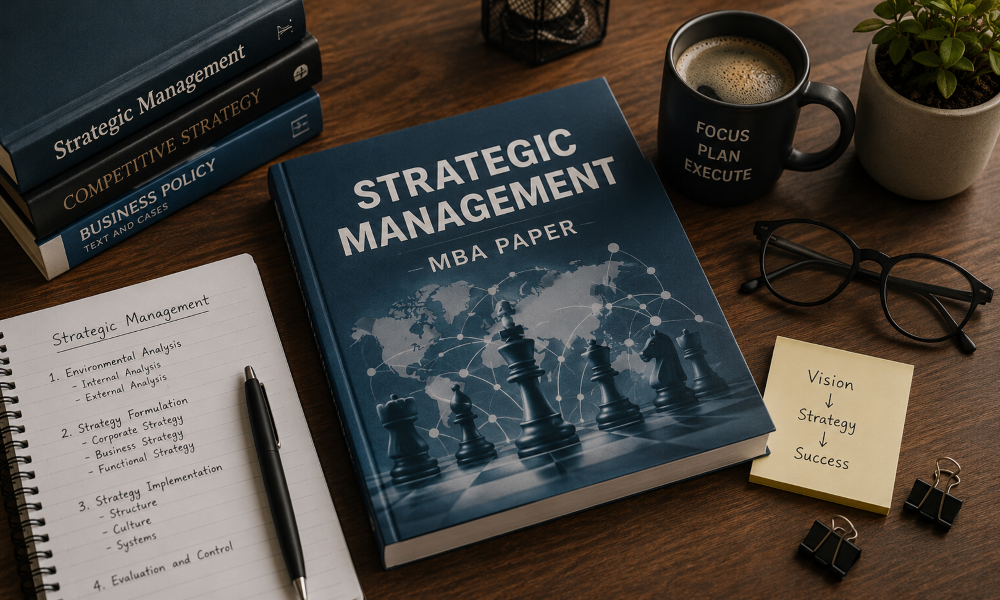
Strategic Management MBA Paper with Solution

Strategic management helps businesses create long-term success through planning, analysis, and execution. MBA students study strategic management to understand market competition, leadership, organizational growth, and decision-making. A solved strategic management MBA paper improves subject understanding and helps students prepare for exams, assignments, and professional business challenges with practical and theoretical knowledge.
Strategic Management MBA Paper with Solution
Question 1: What Is Strategic Management?
Strategic management is the process of planning, implementing, and evaluating business strategies to achieve organizational goals. Strategic management helps businesses gain competitive advantage, improve operational efficiency, and respond to market changes.
The strategic management process includes:
- Environmental scanning
- Strategy formulation
- Strategy implementation
- Strategy evaluation
Organizations use strategic management to align resources with long-term objectives. Strategic management also supports innovation, risk management, and sustainable business growth.
Question 2: Explain SWOT Analysis with Example
SWOT analysis is a strategic planning framework used to identify strengths, weaknesses, opportunities, and threats.
Strengths
Strengths are internal advantages that improve business performance.
Examples:
- Strong brand reputation
- Skilled workforce
- Advanced technology
Weaknesses
Weaknesses are internal limitations that reduce efficiency.
Examples:
- High operational costs
- Limited market presence
- Weak customer service
Opportunities
Opportunities are external factors that support growth.
Examples:
- Emerging markets
- Digital transformation
- Increasing customer demand
Threats
Threats are external risks that can harm business performance.
Examples:
- Economic recession
- Intense competition
- Government regulations
For example, Apple uses strong product innovation as a major strength while facing competition from global smartphone manufacturers as a business threat.
Question 3: Discuss Porter’s Five Forces Model
Michael Porter developed Porter’s Five Forces Model to analyze industry competition and profitability.
The five forces include:
Competitive Rivalry
High competition reduces profitability. Businesses compete through pricing, quality, and innovation.
Threat of New Entrants
New companies entering the market increase competitive pressure.
Bargaining Power of Suppliers
Strong suppliers can increase prices and reduce company profits.
Bargaining Power of Buyers
Customers with more choices can demand lower prices and better services.
Threat of Substitutes
Alternative products can reduce demand for existing products.
Porter’s Five Forces Model helps organizations develop strong competitive strategies and market positioning.
Question 4: What Is Corporate Strategy?
Corporate strategy defines the overall direction of an organization. Corporate strategy focuses on business expansion, diversification, mergers, and acquisitions.
Types of corporate strategies include:
- Growth strategy
- Stability strategy
- Retrenchment strategy
- Diversification strategy
For example, Amazon uses diversification strategy by operating in e-commerce, cloud computing, entertainment, and logistics sectors.
Question 5: Explain Competitive Advantage
Competitive advantage refers to factors that allow a company to outperform competitors. Competitive advantage improves profitability and market share.
Types of competitive advantage include:
Cost Leadership
Businesses offer products at lower costs than competitors.
Example:
Walmart uses large-scale operations to maintain low product prices.
Differentiation Strategy
Businesses offer unique products or services.
Example:
Tesla differentiates through electric vehicle technology and innovation.
Focus Strategy
Businesses target a specific market segment.
Example:
Luxury brands target premium customers with exclusive products.
Question 6: Describe Strategy Implementation
Strategy implementation converts plans into actions. Successful strategy implementation requires effective leadership, communication, and resource allocation.
Important elements include:
- Organizational structure
- Employee training
- Budget management
- Performance monitoring
- Leadership support
Poor implementation can cause strategic failure even when planning is effective.
Question 7: Explain Strategic Evaluation and Control
Strategic evaluation measures organizational performance and identifies improvement areas. Businesses compare actual results with planned objectives.
Key evaluation methods include:
- Financial analysis
- Balanced scorecard
- Performance indicators
- Customer feedback
Strategic control helps organizations adapt to changing market conditions and business risks.
Importance of Strategic Management in MBA Programs
Strategic management is an important MBA subject because it develops analytical and leadership skills. MBA students learn how organizations make long-term business decisions in competitive environments.
Benefits of studying strategic management include:
- Improved decision-making skills
- Better understanding of business competition
- Enhanced leadership capabilities
- Increased problem-solving ability
- Stronger business planning knowledge
Strategic management also prepares MBA graduates for managerial and executive roles.
Key Strategic Management Theories
Resource-Based View Theory
Resource-Based View Theory states that internal resources create competitive advantage. Valuable and unique resources improve long-term business success.
Examples of strategic resources include:
- Brand value
- Skilled employees
- Intellectual property
- Advanced technology
Balanced Scorecard Theory
The Balanced Scorecard measures organizational performance using financial and non-financial indicators.
Four major perspectives include:
- Financial performance
- Customer satisfaction
- Internal processes
- Learning and growth
Businesses use balanced scorecards to improve strategic alignment and operational performance.
Blue Ocean Strategy
Blue Ocean Strategy focuses on creating uncontested market space instead of competing directly in saturated markets.
Companies using Blue Ocean Strategy emphasize:
- Innovation
- Value creation
- Customer experience
- Market differentiation
Common Challenges in Strategic Management
Organizations face several strategic management challenges.
Rapid Market Changes
Technology and customer preferences change quickly. Businesses must adapt continuously.
Global Competition
International companies increase market competition and pricing pressure.
Resource Limitations
Limited financial and human resources affect strategic execution.
Resistance to Change
Employees may resist organizational changes due to uncertainty and fear.
Businesses overcome these challenges through effective leadership, communication, and strategic flexibility.
Tips to Write Strategic Management MBA Answers
MBA students can improve answer quality by following structured writing methods.
Use Business Examples
Real business examples improve answer credibility and practical understanding.
Explain Concepts Clearly
Simple explanations improve readability and examiner understanding.
Use Headings and Points
Organized answers increase presentation quality and logical flow.
Include Strategic Frameworks
Frameworks such as SWOT analysis and Porter’s Five Forces strengthen academic answers.
Focus on Practical Application
Examiners value practical business understanding along with theoretical knowledge.
FAQs
What is the primary objective of strategic management?
The primary objective of strategic management is to achieve long-term organizational success and competitive advantage.
Why is strategic management important for managers?
Strategic management helps managers make informed business decisions and improve organizational performance.
What is environmental scanning in strategic management?
Environmental scanning identifies internal and external business factors that affect organizational strategy.
How does innovation support business strategy?
Innovation improves product quality, customer satisfaction, and market competitiveness.
What is strategic leadership?
Strategic leadership involves guiding organizations toward long-term goals through vision and decision-making.
Final Verdict
Strategic management MBA papers help students understand real-world business strategy, competition, leadership, and organizational planning. A properly solved strategic management paper improves academic performance and strengthens managerial knowledge. MBA students who understand strategic frameworks, implementation methods, and evaluation techniques develop stronger analytical skills for future business leadership and corporate decision-making responsibilities.