
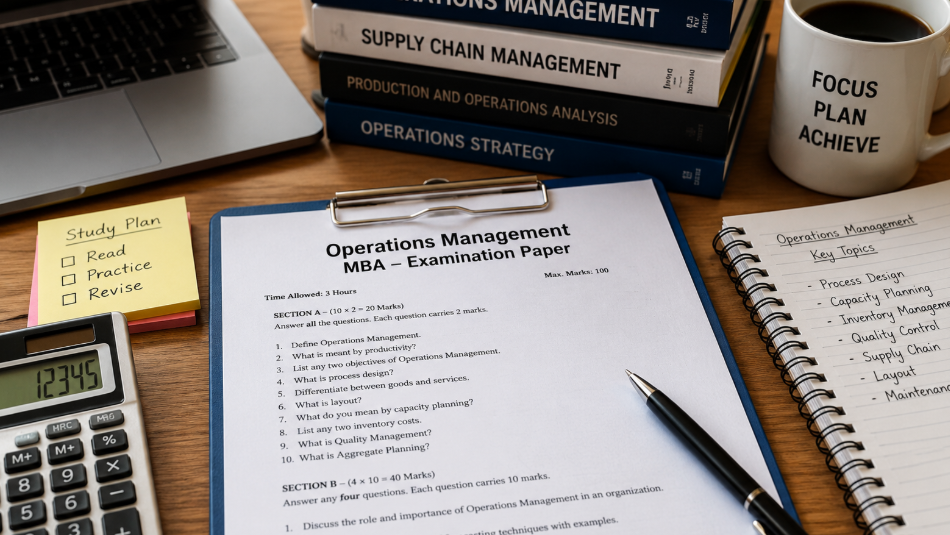
Operations Management MBA Paper with Solution

Operations management is an important subject in MBA programs because it helps students understand how businesses manage production, services, quality, and resources efficiently. This paper provides solved content related to operations management concepts, strategies, and practical applications in modern organizations using simple explanations that are easy to understand for students and learners.
Operations Management MBA Paper with Solution
Operations management is the process of planning, organizing, and supervising production and business operations. It focuses on improving efficiency, reducing costs, and delivering quality products or services to customers. In MBA studies, operations management plays a major role because every organization depends on smooth operational activities for success.
One of the key functions of operations management is production planning. Production planning ensures that resources such as labor, machinery, and materials are used effectively. Managers create schedules, estimate demand, and manage inventory to avoid shortages or overproduction. Proper planning increases productivity and reduces waste.
Another important concept is quality management. Quality management ensures that products and services meet customer expectations. Businesses use quality control tools, inspections, and improvement techniques to maintain standards. Total Quality Management (TQM) is a common approach that focuses on continuous improvement and customer satisfaction.
Inventory management is also a major topic in operations management. Companies must maintain the right level of stock to avoid unnecessary costs. Too much inventory increases storage expenses, while too little inventory can lead to delays and lost sales. Techniques such as Just-in-Time (JIT) help businesses reduce excess inventory and improve efficiency.
Supply chain management is closely connected with operations management. It involves coordinating suppliers, manufacturers, warehouses, and retailers to deliver products on time. Effective supply chain management helps businesses reduce transportation costs, improve delivery speed, and satisfy customers.
Operations managers also focus on process design. Process design means creating workflows that improve efficiency and reduce delays. Businesses often analyze processes to identify unnecessary steps and improve productivity. Automation and technology are commonly used to simplify operations and save time.
Capacity planning is another important area. Capacity planning helps organizations determine the amount of production needed to meet customer demand. If capacity is too low, customers may face delays. If capacity is too high, resources may remain unused, leading to higher costs. Managers use forecasting methods to balance demand and production capacity.
Project management is often included in operations management studies. Project management involves planning, organizing, and controlling projects within a specific budget and time frame. Tools such as Gantt charts and Critical Path Method (CPM) help managers monitor progress and complete projects successfully.
Technology has greatly changed operations management in modern businesses. Companies use software systems, artificial intelligence, and automation to improve operational efficiency. Enterprise Resource Planning (ERP) systems integrate different business functions and improve coordination among departments.
Risk management is also essential in operations management. Businesses face risks such as supply chain disruptions, machine failures, labor shortages, and changing customer demands. Operations managers prepare backup plans and strategies to minimize risks and ensure business continuity.
Sustainability has become an important part of operations management. Many companies now focus on environmentally friendly practices such as reducing waste, recycling materials, and saving energy. Sustainable operations help businesses improve their public image and meet environmental regulations.
Importance of Operations Management in Business
Operations management is important because it directly affects productivity, profitability, and customer satisfaction. Efficient operations reduce costs and improve product quality. Businesses that manage operations effectively can compete better in the market and achieve long-term success.
Operations management also helps organizations make better decisions. Managers analyze data related to production, inventory, and customer demand to improve performance. Good decision-making leads to better resource utilization and higher efficiency.
Customer satisfaction is strongly connected with operations management. Customers expect quality products and timely delivery. Efficient operations ensure that businesses can meet these expectations consistently. Companies with strong operational systems often build loyal customer relationships.
Key Functions of Operations Management
Planning
Planning involves setting goals, forecasting demand, and preparing production schedules. Proper planning helps businesses avoid confusion and improve workflow.
Organizing
Organizing ensures that resources, employees, and equipment are arranged properly. This helps businesses achieve operational goals efficiently.
Controlling
Controlling includes monitoring performance, checking quality, and solving operational problems. Managers compare actual performance with planned targets to maintain efficiency.
Improving Processes
Operations managers continuously improve processes to increase productivity and reduce costs. Process improvement techniques help businesses remain competitive.
Challenges in Operations Management
Businesses face several challenges in operations management. One common challenge is managing changing customer demands. Companies must quickly adapt to market trends and customer preferences.
Another challenge is supply chain disruption. Natural disasters, transportation issues, and global events can affect the supply chain and delay deliveries. Businesses need flexible strategies to handle such situations.
Managing employee performance is also difficult. Operations managers must motivate employees, provide training, and maintain teamwork for better productivity.
Technology implementation can sometimes create challenges as well. Businesses may face high costs, employee resistance, or technical issues while adopting new systems and automation tools.
Role of Technology in Operations Management
Technology improves speed, accuracy, and efficiency in business operations. Automated systems reduce manual work and minimize errors. Businesses use robotics, cloud computing, and data analytics to improve operational performance.
Artificial intelligence helps businesses predict demand, manage inventory, and improve customer service. Data analytics also allows managers to make better decisions based on accurate information.
Online systems and digital platforms have improved communication between suppliers, manufacturers, and customers. Technology has become a necessary part of modern operations management.
Strategies for Effective Operations Management
Businesses can improve operations management by using effective strategies. One strategy is continuous improvement, where companies regularly evaluate and improve processes.
Employee training is another important strategy. Skilled employees perform tasks more efficiently and contribute to organizational success.
Businesses should also focus on customer feedback. Understanding customer needs helps organizations improve products and services.
Using modern technology and automation tools can increase operational efficiency and reduce costs. Companies that invest in innovation often gain competitive advantages.
Frequently Asked Questions
What is the main goal of operations management?
The main goal is to improve efficiency while delivering quality products and services to customers.
Why is inventory management important?
Inventory management helps businesses reduce costs and avoid shortages or overstock situations.
How does technology support operations management?
Technology improves productivity, accuracy, communication, and decision-making in business operations.
What skills are needed for operations management?
Problem-solving, leadership, planning, communication, and analytical skills are important for operations managers.
What is the difference between production and operations management?
Production management focuses on manufacturing, while operations management covers both products and services.
Final Verdict
Operations management is a vital part of every successful business because it improves productivity, quality, and customer satisfaction. MBA students benefit greatly from learning operational strategies, planning methods, and process improvement techniques. Strong operations management allows organizations to reduce waste, manage resources effectively, and achieve sustainable growth in competitive business environments.